


Table of Contents
The GPU generation determines which numerical formats (precisions) the processor handles AI workloads fastest, its memory bandwidth and the card’s power requirements. Three generations coexist in the NVIDIA professional GPU portfolio: Ampere (e.g. RTX A6000), Ada Lovelace (e.g. RTX 6000 Ada) and Blackwell (e.g. RTX PRO 6000 Blackwell). Each successive generation supports lower compute precisions – from BF16 in Ampere to FP4 in Blackwell.
The choice of generation depends on model size, compute format, number of users and hardware operating conditions. GPU types, VRAM capacity, and OEM, Retail and Bulk variants are covered in the GPUs for AI. This article focuses on the differences between generations and editions. It is intended for IT managers, infrastructure architects, data science teams and hardware procurement professionals selecting GPUs for enterprise AI projects.
How to identify the generation from an NVIDIA GPU name
The generation of an NVIDIA GPU can be identified by the designation in its model name. The number in the name (e.g. 2000, 4000, 6000) indicates the card’s performance tier within a given generation: the higher the number, the more cores and memory it has. This is why the same tier appears under different names in successive generations, for example: RTX A6000 (Ampere), RTX 6000 Ada (Ada Lovelace) and RTX PRO 6000 Blackwell (Blackwell).
| Generation | Year | Workstation GPUs | Server GPUs | Examples in the portfolio |
|---|---|---|---|---|
| Blackwell | 2025 | RTX PRO + number + Blackwell | RTX PRO + number + Blackwell Server Edition | RTX PRO 2000 Blackwell |
| Ada Lovelace | 2022 | RTX + number + Ada | L + number | L4 |
| Ampere | 2020 | RTX A + number | A + number | RTX A1000 |
What changes between generations for AI workloads
Successive generations differ primarily in supported compute precisions, memory bandwidth and power consumption.
The growing importance of lower precisions is confirmed by the AI Index 2026 report from Stanford University: reduced-precision computing has become standard in many applications, both for model training and inference. According to the report’s authors, today’s state-of-the-art machine learning hardware delivers approximately 10 times more computations per watt than it did a decade ago. Each GPU generation pushes this boundary further: Ampere accelerates BF16 computations, Ada Lovelace added FP8, and Blackwell adds FP4 and FP6.
The comparison below covers three GPUs from the same tier (6000).
| Specification | RTX A6000 (Ampere) | RTX 6000 Ada (Ada Lovelace) | RTX PRO 6000 Blackwell Workstation Edition |
|---|---|---|---|
| Tensor Core generation | 3. | 4. | 5. |
| Precisions accelerated by Tensor Cores | TF32, BF16, FP16, INT8 | same as Ampere + FP8 | same as Ada + FP6, FP4 |
| Memory | 48 GB GDDR6 | 48 GB GDDR6 | 96 GB GDDR7 |
| Memory bandwidth | 768 GB/s | 960 GB/s | 1792 GB/s |
| FP16 Tensor performance | 154,8 TFLOPS | 364 TFLOPS | 503,8 TFLOPS |
| Power consumption (TGP) | 300 W | 300 W | 600 W |
| Interface | PCIe 4.0 | PCIe 4.0 | PCIe 5.0 |
Ampere
Ampere (2020) introduced third-generation Tensor Cores and the TF32 and BF16 formats, widely used for model training. GPUs from this generation do not provide hardware acceleration for FP8 computations. Higher-end workstation GPUs in the RTX A series, such as RTX A6000, support NVLink bridges for connecting two cards. The compact RTX A1000 and RTX A400 are well suited to low-power workstations.
Ada Lovelace
Ada Lovelace (2022) introduced fourth-generation Tensor Cores with support for FP8, which reduces memory requirements and, according to the manufacturer, delivers up to 4 times higher inference performance than the previous generation. This generation includes RTX Ada workstation GPUs and the L4, L40 and L40S server accelerators.
Blackwell
Blackwell (the RTX PRO series from 2025) introduces fifth-generation Tensor Cores supporting FP4 and FP6, as well as GDDR7 memory. According to NVIDIA, a model in FP4 uses less than half the memory required in FP16. According to manufacturer data, the RTX PRO 6000 Blackwell generates an image using the FLUX.dev model in approximately 7 s in BF16 and 3,3 s in FP4.
When to choose a Blackwell-generation GPU
The Blackwell generation is well suited to organisations that want to run large models on a single GPU, use FP4 quantisation or share one card across multiple teams. These capabilities result from specific architectural features:
- Support for FP4 and FP6 – lower precision enables a larger model to run within the same memory capacity and accelerates inference. Fifth-generation Tensor Cores process FP4 with twice the throughput of FP8.
- GDDR7 memory – the newer memory standard provides higher bandwidth than GDDR6. The top models in the generation have twice the memory capacity and twice the bandwidth of their previous-generation counterparts.
- MIG (Multi-Instance GPU) – a single card can be partitioned into several isolated instances. Each has its own memory and compute cores, allowing multiple workloads or teams to work in parallel without affecting one another’s performance.
- PCIe 5.0 – twice the bus bandwidth of PCIe 4.0 speeds up data exchange with the processor and system memory.
- Wide choice of tiers – the RTX PRO series includes both compact cards for small form factors and high-memory-capacity models for the most demanding workloads.
When planning a configuration, it is worth considering power consumption: the RTX PRO 6000 Blackwell Workstation Edition requires up to 600 W, twice as much as the RTX 6000 Ada. This affects the choice of power supply and cooling and, when using multiple cards, the choice of edition discussed later in this article.
When an Ampere or Ada Lovelace GPU meets the requirements
Ampere and Ada Lovelace GPUs are well suited to business requirements when the model fits in their memory and the workload uses formats accelerated by these generations. This most commonly applies to the following scenarios:
- Models in FP16 and BF16 formats – both formats are accelerated by the Tensor Cores in all three generations. If the company does not plan to quantise to FP8 or FP4, the Ampere generation will support the same models.
- Inference in FP8 – the Ada Lovelace generation provides hardware support for FP8. This generation also includes energy-efficient server accelerators designed for inference and video processing.
- Expanding existing infrastructure – purchasing cards from the same generation as those already in use makes it easier to maintain consistent drivers, system images and procedures.
- Connecting two GPUs in a workstation via an NVLink bridge – among workstation GPUs, this is supported by higher-end RTX A series models (Ampere).
- Virtualisation and mixed workloads – Ada Lovelace server accelerators combine inference with virtual workstations and video processing.
- Compact systems – low-profile Ampere and Ada Lovelace GPUs fit into small enclosures and are well suited to lighter models.
Before purchasing, check whether the AI libraries and frameworks in use support the chosen generation in the required CUDA version.
Same generation, different editions – using the RTX PRO 6000 Blackwell as an example
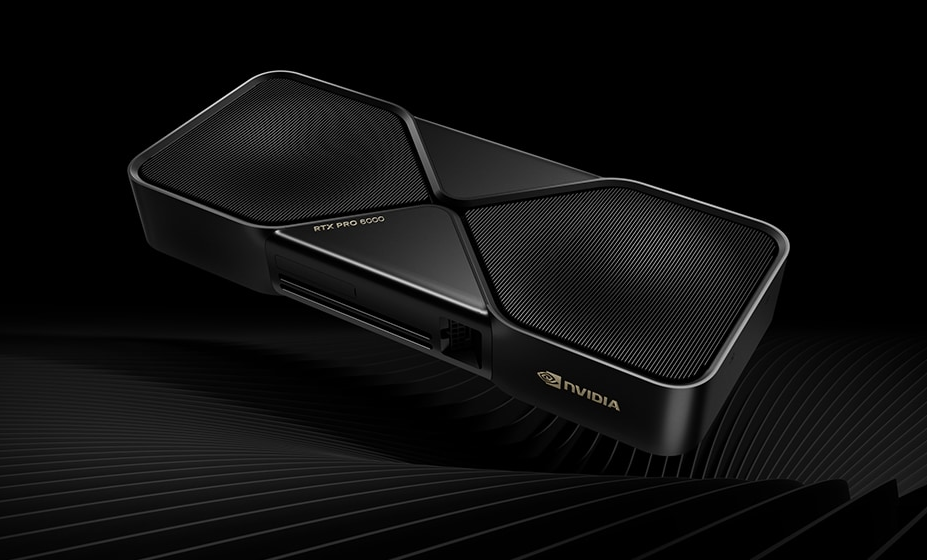
Within a single generation, the same GPU model may be available in several editions. The RTX PRO 6000 Blackwell is available in three editions: Workstation Edition, Max-Q Workstation Edition and Server Edition. All use the same GB202 chip and have 96 GB of GDDR7 memory. They differ in cooling, power limit and intended installation environment.
| Specification | Workstation Edition | Max-Q Workstation Edition | Server Edition |
|---|---|---|---|
| Cooling | active, 2 fans | active, 1 fan | passive (heatsink) |
| Power consumption | up to 600 W | 300 W | up to 600 W (configurable) |
| Card length | 304,8 mm | 266,7 mm | 266,7 mm |
| Memory bandwidth | 1792 GB/s | 1792 GB/s | 1597 GB/s |
| Video outputs | 4 × DisplayPort 2.1b | 4 × DisplayPort 2.1b | 4 × DisplayPort 2.1 |
| Deployment environment | workstation | workstation, including multi-GPU configurations | server with forced-air cooling |
| Example product | NVIDIA 900-5G144-2500-000 | NVIDIA 900-5G153-2500-000 | PNY TCSRTXPRO6000SE-BLK |
Workstation Edition
The Workstation Edition operates at the full 600 W power limit and has two dedicated fans to dissipate heat from the card. It is designed for single-GPU workstations where maximum single-GPU performance is the priority.
Max-Q Workstation Edition
The Max-Q Workstation Edition operates at a 300 W power limit, half that of the Workstation Edition, while offering the same memory capacity and bandwidth. Lower power consumption means less heat to remove from the enclosure. Up to four cards in this edition can be installed in a single workstation, providing a total of 384 GB of GPU memory.
Server Edition
The Server Edition has no fans. Heat is dissipated by the airflow generated by the server fans, so this edition is designed for servers with forced-air cooling rather than workstation enclosures. These cards are optimised for continuous operation in data centres and support, among other capabilities, secure boot and confidential computing.
The same edition split is also available for other RTX PRO Blackwell series models.
GPU generation and edition by AI workload
Choosing a GPU starts with the workload it must handle: prototyping on a single system has different requirements from inference for an entire team or training large models. The table below matches common business AI workloads with the GPU generation and edition that meet their requirements.
| AI workload | Generation | Edition or form factor | Example products |
|---|---|---|---|
| Prototyping and testing smaller models on a single system | Ada Lovelace or Blackwell | workstation, compact GPU | RTX PRO 4000 SFF Blackwell |
| Models in FP16 or BF16, expanding workstations with Ampere GPUs | Ampere | workstation | RTX A1000 |
| Local language model for a team, inference in FP8 | Ada Lovelace | workstation | RTX 6000 Ada |
| Large model on a single GPU, FP4 quantisation | Blackwell | Workstation Edition | RTX PRO 6000 Blackwell Workstation Edition |
| Multiple GPUs in a single workstation | Blackwell | Max-Q Workstation Edition | RTX PRO 6000 Blackwell Max-Q |
| Low-power server inference, video processing | Ada Lovelace | low-profile server accelerator | L4 |
| Multimodal inference in a server, partitioning a GPU between teams (MIG) | Blackwell | Server Edition | RTX PRO 6000 Blackwell Server Edition |
We cover selecting an entire system in separate articles: how to choose a computer for AI, a server for AI and when to run a language model on your own hardware.
Frequently asked questions about GPU generations for AI
A newer generation offers higher peak performance and support for lower precisions, but the benefit depends on the workload. If a model runs in FP16 or BF16 and fits in GPU memory, GPUs from all three generations (Ampere, Ada Lovelace and Blackwell) accelerate it in hardware. The greatest difference is seen with models quantised to FP8 or FP4, and with models that require large amounts of memory.
These are GPUs in the same class from three successive generations. RTX A6000 (Ampere) and RTX 6000 Ada each have 48 GB of GDDR6 memory and a power draw of 300 W. RTX PRO 6000 Blackwell has 96 GB of GDDR7 memory with bandwidth of 1792 GB/s and is the only one of the three to support FP4.
Yes. Ampere-generation GPUs accelerate computations in the TF32, BF16 and FP16 formats, which are used for training and inference across many models. They do not provide hardware acceleration for the FP8 format, which is supported by the Ada Lovelace and Blackwell generations.
Precision is the format used to store a model’s numbers, such as FP16, FP8 or FP4. The fewer the bits, the less memory the model requires and the faster it runs. Output quality at lower precision depends on the quantisation method used.
FP4 is a 4-bit numerical format in which a model occupies less than half the memory required by FP16. Fifth-generation Tensor Cores process FP4 at twice the throughput of FP8. This makes it possible to run a larger model on a single GPU or accelerate inference.
Workstation GPUs labelled RTX A belong to the Ampere generation, GPUs with the Ada suffix belong to Ada Lovelace, and the RTX PRO series with the Blackwell suffix belongs to the Blackwell generation. For server accelerators, the first letter of the name indicates the generation: A for Ampere and L for Ada Lovelace.
All three editions use the same chip and have 96 GB of GDDR7 memory. Workstation Edition operates at up to 600 W with active cooling, Max-Q at 300 W with active cooling, while Server Edition uses passive cooling designed for servers with forced airflow.
Yes, if the GPU supports MIG (Multi-Instance GPU) technology. RTX PRO 6000 Blackwell can be partitioned into up to four isolated instances of 24 GB each, with dedicated memory and compute cores.
