


Table of Contents
Vertiv is one of the world’s largest manufacturers of critical infrastructure for data centres, telecommunications networks and enterprise server rooms. Its scale: approximately USD 10.2 billion in revenue, around 34 000 employees, 30 manufacturing facilities and a presence in more than 130 countries. Its portfolio includes uninterruptible power supplies, power distribution, precision cooling, rack cabinets and IT management systems – in other words, virtually all server room equipment apart from the servers themselves.
The company is younger than its products. Its heritage dates back to 1946, when Ralph C. Liebert founded Capitol Refrigeration Industries, while Liebert Corporation – the first manufacturer of precision air conditioning for server rooms – was established in 1965. Emerson acquired the company in 1987, and it was spun off as Vertiv in 2016. This is why premium UPS systems still carry the Liebert name (GXT5, GXE), PDUs bear the Geist brand, and KVM switches and console servers are marketed as Avocent. These are not separate companies, but product lines with a long history.
For IT departments, service matters more than history. Vertiv operates around 320 service centres and employs approximately 5 000 field engineers, including around 60 centres and approximately 700 engineers in the EMEA region. With equipment expected to operate for 8–10 years and requiring battery replacement every few years, the availability of parts and local support matters as much as the specifications on the datasheet.
What makes up rack power infrastructure
Complete rack power infrastructure comprises four layers that need to be selected together – the absence of any one of them only becomes apparent during an outage.
- Backup power – UPS. It keeps equipment running during a power outage and filters disturbances from the mains supply. It determines whether servers have enough time to shut down in a controlled manner or are powered off while data is being written.
- Distribution – rack PDU. It distributes power from the UPS or mains supply to individual devices. Managed versions measure power consumption and allow individual outlets to be switched remotely.
- Rack cabinet – a rack cabinet with perforated doors, cable management and airflow organisation. Perforated front and rear doors enable efficient cooling, while cable routing is kept orderly – both factors determine how quickly a specific cable can be identified and how safely changes can be made in an operational cabinet.
- Remote access – UPS network cards, a KVM over IP switch and a serial console server. They enable access to equipment when the operating system is unresponsive or the production network is unavailable.
Vertiv supplies all four layers under one brand, simplifying compatibility (for example, tool-free PDU installation in VR cabinets) and subsequent servicing.
Vertiv UPS systems – from the desktop to the server room
The single-phase UPS range is divided into three distinct tiers. They differ less in capacity than in topology – and it is topology that determines which devices can be connected to a particular UPS.
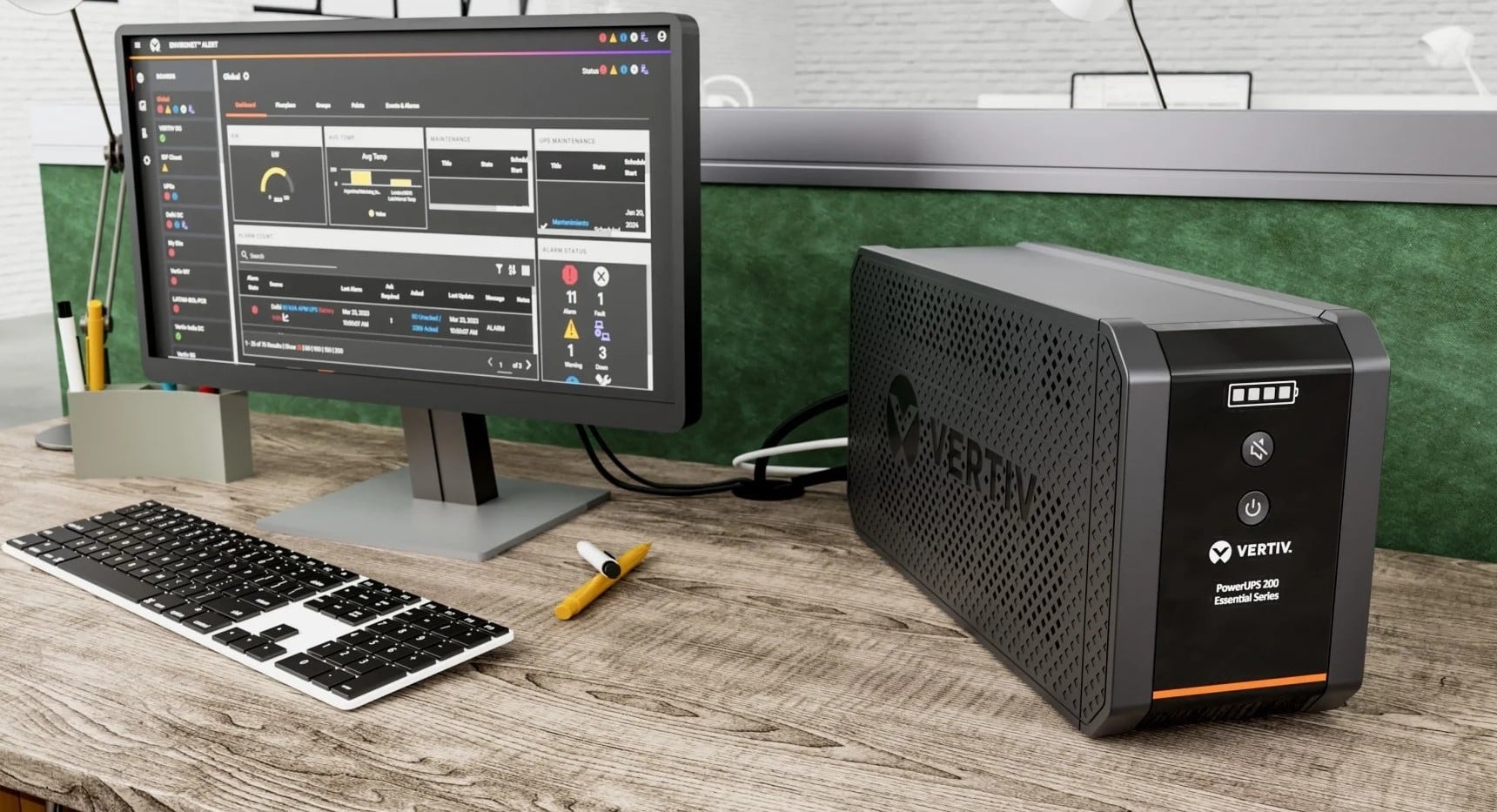
PowerUPS 100 and 200 – workstation protection
PowerUPS is an offline UPS range, approximately 350 VA to 2,2 kVA, in a desktop enclosure. This is the entry-level tier: a computer, monitor, cash register, CCTV recorder, router, access point, or compact AI workstations such as the NVIDIA DGX Spark. The UPS systems correct undervoltage and overvoltage using AVR regulation, switching to battery power only in the event of more significant deviations. Outlets are divided into battery-backed and surge-protected only, while some models also feature a RJ45 port to protect network or telephone lines.
The manufacturer positions this series as protection for workstations and peripheral devices – it uses a desktop enclosure, offers no rack mounting and does not support battery replacement while in operation. For server equipment requiring zero transfer time and installation in a 19″ rack, Vertiv offers the rack/tower series described below.
Liebert EDGE and GXE – edge deployments and mid-sized installations
Liebert EDGE comprises line-interactive rack/tower UPS systems (1U and 2U), ranging from 500 VA to 3 kVA. They are suitable for edge racks, branch server rooms and telecommunications cabinets housing a switch, recorder and one or two servers where space is limited.
Liebert GXE uses online double-conversion topology in the 1–3 kVA range, up to 10 kVA, with an output power factor of 0,9, a rack/tower enclosure and a fast charger. Output voltage is regenerated from scratch, independently of input power quality, with zero transfer time. The series is designed for installations requiring power continuity where the feature set may be narrower than in the GXT5 series. Remote monitoring is available through an optional RDU120 card.
Liebert GXT5 – entry-level rack UPS
GXT5 is Vertiv’s entry-level rack UPS. Online double conversion, capacities from 1 to 10 kVA, 16 kVA and 20 kVA, with a rack/tower enclosure and a complete mounting kit included (2U for lower capacities, 4U and 5U for higher capacities). A power factor of 1,0 means that 3 kW can be drawn in practice from a 3 kVA UPS – so there is no need to oversize it for modern servers.
Features that distinguish this series from line-interactive models include batteries that can be replaced without shutting down the load (hot-swap), battery health management with replacement-date forecasting, a colour LCD that rotates according to the mounting orientation, ECO mode and ENERGY STAR 2.0 certification (valid in the USA only). All GXT5 models are available with a RDU120 card included. The standard manufacturer’s warranty is 3 years, with an option to extend it to 5 years.
Battery modules and IntelliSlot cards / RDU120
Runtime on internal batteries is typically several to a dozen or so minutes at full load. Where more is required – for example, to enable an orderly cluster shutdown or ride through typical power outages without starting a generator – external rack-mount battery modules can be added to the GXT5 and GXE series. They are connected in series, and the UPS automatically recalculates the available runtime.
The IntelliSlot slot is used for communication cards. The key card, RDU120, gives the UPS its own IP address, providing a web interface, SNMP, email event notifications, integration with monitoring systems and network-triggered operating system shutdowns. Without a card, the UPS communicates only locally via a serial port or USB – which at a remote site usually means no visibility of a failure at all. The free Vertiv Power Insight software consolidates data from distributed units in a single view.
View Vertiv 1-phase UPS systems →
Vertiv Geist Rack PDU
Geist PDUs are the most extensive part of Vertiv’s power distribution portfolio. They are available in horizontal (1U) and vertical (0U, installed in the side space of the rack) versions, for 16 A, 32 A and more, in single-phase and three-phase configurations, with C13 and C19 outlets featuring a U-Lock retention mechanism to prevent accidental plug disconnection. A separate range is available for environments with elevated operating temperatures (up to 60°C).
Basic, Monitored, Switched – what each level actually delivers
Basic provides distribution only: it distributes power and does not measure anything. It is sufficient for racks with known, stable loads where measurement is handled by the UPS or the electrical distribution board.
Monitored is a managed PDU in the basic sense: a network interface, browser and SNMP access, threshold alerts, power consumption history, and optional environmental sensors for temperature, humidity, water leaks and door opening. This level is used where energy consumption is billed, rack capacity is being planned, or the server room is managed remotely.
Switched adds remote switching of individual outlets. This matters in three situations: restarting a device that has frozen and does not respond through any interface; turning off less critical loads during battery operation to extend runtime for critical equipment; and locking unused outlets to prevent anyone from overloading the circuit. In colocation facilities and remote locations, this function reduces the number of service visits.
A feature shared by all levels is that monitoring functions are provided by a replaceable IMD (Interchangeable Monitoring Device) module, which can be replaced without disconnecting power. A Basic PDU in the “Upgradeable” version can therefore later be upgraded to Monitored or Switched by adding a module, rather than buying a new PDU and reconnecting the entire rack.
Vertiv Geist Rack Transfer Switch
Above the individual rack level, the portfolio includes cabinet PDUs – devices that accept a single high-current power supply and distribute it across circuits feeding individual racks, with overcurrent protection and per-circuit metering. They are used in larger server rooms where running a separate cable from the main distribution board to every rack is no longer practical, as well as where energy consumption needs to be billed per customer or department.
View the Vertiv Geist PDU range →
Vertiv VR Rack enclosures
The VR family includes around 40 variants of freestanding racks in 42U and 48U heights, with several widths and depths. The frame design provides approximately 6 cm more usable depth than a typical 19″ rack, which is important for modern servers and rear-routed cabling. Load capacity reaches 1360 kg.
As standard, the racks feature perforated front and rear doors, removable side panels, depth-adjustable 19″ rails and a top cable entry point. The 0U spaces are designed for tool-free PDU installation.
Additional accessories are selected separately: fixed and sliding shelves, blanking and brush panels, vertical and horizontal cable managers, ventilation panels, cold-aisle sealing kits, doors with different perforation levels, colocation kits that divide the rack into independently lockable sections for different tenants, and aisle containment components. Vertiv also offers factory integration of Geist PDUs with VR racks, delivering racks with PDUs installed and configured.
View Vertiv VR Rack enclosures →
Avocent – remote access to the server room
Avocent is the brand under which Vertiv sells out-of-band management hardware, providing access to servers and network devices regardless of the state of the operating system or production network.
KVM and KVM over IP switches
A traditional KVM switch enables several or a dozen or so servers to be operated from a single console – keyboard, monitor and mouse – typically housed in an LCD drawer in the rack. It saves space and eliminates the need to connect a monitor to each server separately.
A KVM over IP switch brings the same console into the browser. The administrator can view the server’s graphics port output and control the keyboard and mouse over the network – even when the server has failed to boot, is stopped at the BIOS/UEFI screen, is waiting for a disk encryption password or displays an error message. Remote mounting of ISO images is also possible, enabling operating system installation without being physically present at the equipment. The range includes models from compact single-port units to multi-port rack switches, with authentication, access control and session logging.
Serial console servers
A serial console server does the same for devices without a graphical output: switches, routers, firewalls, storage arrays and UPS systems. They are connected via RS-232 ports to a single device with its own IP address, providing remote access to the text console that would normally require an on-site laptop and console cable.
The entry-level Avocent ACS 8000 family includes models with 8 to 48 ports, dual Ethernet ports and automatic link failover, with optional cellular network failover. Access is protected by authentication, access control lists and session logging. The console server also supports PDU units and UPS systems, enabling continued access to a remote site after the primary link fails.
View Vertiv IT management systems →
FAQ
Basic PDUs only distribute power and provide no measurement. Monitored PDUs provide remote metering via a web browser and SNMP, with alerts and historical data. Switched PDUs additionally allow individual outlets to be turned on and off remotely, enabling frozen devices to be restarted without a visit to the server room. On Upgradeable Geist PDUs, the monitoring module (IMD) can be replaced later without replacing the entire unit.
They differ in topology and intended use. PowerUPS 200 is a line-interactive desktop UPS rated up to 2,2 kVA, designed to protect computers and peripherals; it switches to battery power when voltage deviation becomes significant. GXT5 is an online double-conversion UPS rated 1–6 kVA in a rack/tower enclosure, with zero transfer time, a power factor of 1,0, hot-swappable batteries and support for additional battery modules. For server applications, the manufacturer offers the Liebert GXE and GXT5 series.
The standard arrangement in a server room is a pair of vertical 0U PDUs – one on each side of the rack, supplied by independent circuits. Servers with two power supplies are then connected to both PDUs, so the failure of one circuit does not interrupt operation. For single-power-supply devices and low loads, one 1U PDU is sufficient. Choose the number of outlets with room for expansion – adding a PDU to a fully populated rack is more troublesome than purchasing a larger one from the outset.
Yes. Vertiv rackmount UPS systems have a standard 19″ width and mount on standard rails, with mounting kits included. Two factors need checking: rack depth (online UPS systems with batteries are typically 60–75 cm deep, plus clearance for cabling) and the load capacity of both the rails and the rack itself – a 6 kVA UPS with batteries weighs several dozen kilograms and should be installed at the bottom of the rack, on suitably rated rails or a shelf.
IntelliSlot is an expansion slot in the UPS, while RDU120 is a network card installed in that slot. The card gives the UPS an IP address and provides a web interface, SNMP, event notifications, monitoring system integration and the ability to automatically shut down operating systems when battery charge is low. Without it, the UPS communicates only locally. In GXT5 models from 5 kVA upwards, the card is included as standard; for lower power ratings, it must be purchased separately.
Remote Desktop is available only once the operating system has started correctly and the network connection is working. KVM over IP captures the video output, allowing work at the BIOS/UEFI screen, when the system fails to boot, when a disk encryption password prompt appears, or after an incorrect network configuration change. It also enables remote mounting of an ISO image and operating system reinstallation. It is a tool for situations in which Remote Desktop is no longer available – the situations that would otherwise require someone to be on site.
